
Innovation Through Connection: Connection Between People
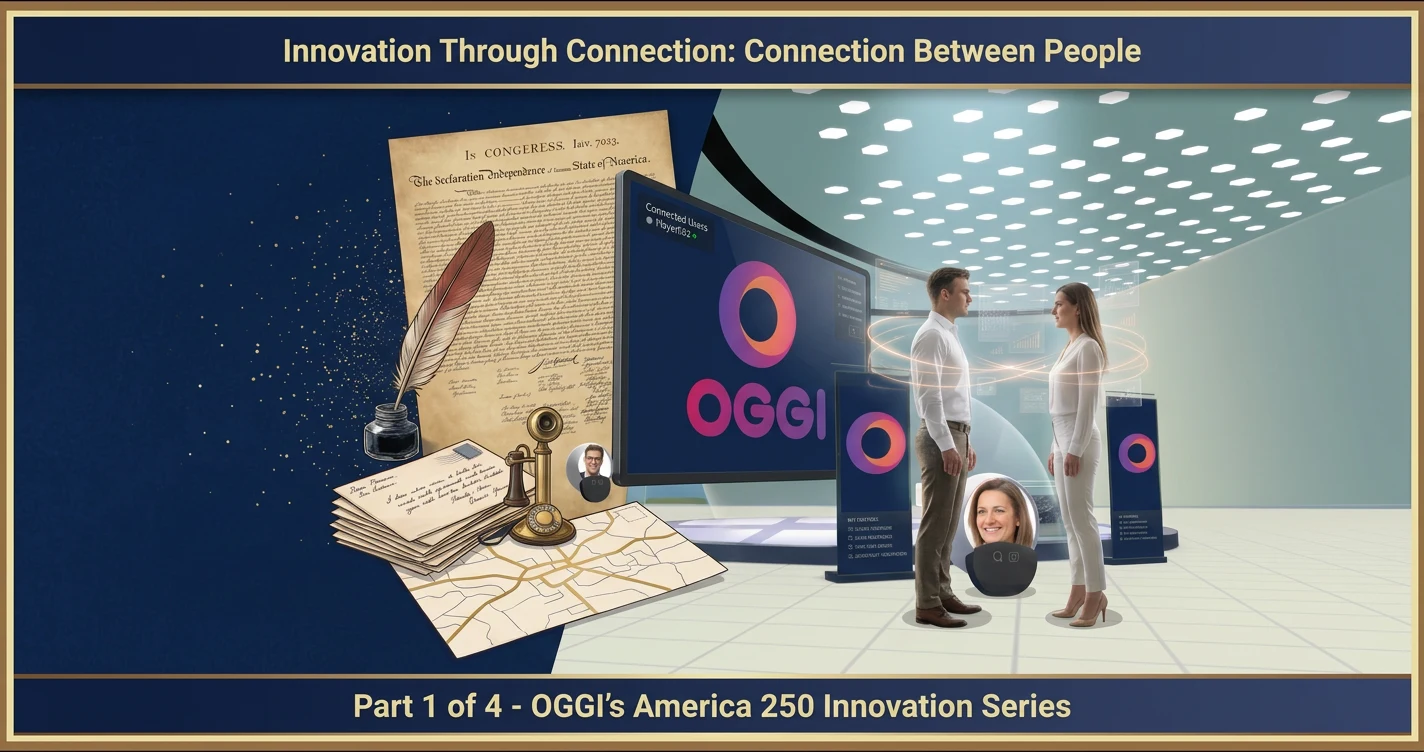
Part 1 of 4 in OGGI's America 250 Innovation Series
Every great communication breakthrough in American history has asked the same question: how can we bring people closer together?
Today, on July 4th, as America celebrates 250 years since the adoption of the Declaration of Independence, we are reminded that innovation was not something that came after America was created. Innovation was required to create America in the first place.
It took bold new thinking to imagine a nation built on self-government, individual liberty, civic participation, and a shared belief that people could shape their own future. It took innovation in communication, organization, law, leadership, publishing, and trust to turn thirteen colonies into one country.
And now, 250 years later, it will take a new generation of innovation to carry that promise forward.
That is why we are launching a four-part article series called Innovation Through Connection.
Over the next few days, we will explore how some of the greatest American innovations were driven by one essential human force: connection.
This series will focus on:
- Connection Between People
- Connection Between Ideas
- Connection Across Communities
- Connection Through Technology
Today, we begin with the most human form of all: connection between people.
America Began as an Act of Connection
Before America could become a country, people had to connect around a shared idea.
The Declaration of Independence, adopted by the Continental Congress on July 4, 1776, was not only a political document. It was also an act of communication. It gave language to a shared vision and sent that message outward to the colonies, to Britain, and to the world.
That alone was a remarkable innovation.
In an era without telephones, radio, television, or the internet, America's founding generation relied on letters, newspapers, pamphlets, riders, public readings, and word of mouth. Connection moved at the speed of paper, horseback, ships, and trust.
The creation of America required people to communicate across distance, coordinate action, debate ideas, and build alignment long before modern communication tools existed.
In many ways, the first American innovation was not a machine. It was the ability to connect people around a common purpose.
The Postal System: Connecting a Young Nation
One of the earliest and most important connection systems in America was the postal network.
Even before independence was declared, the Continental Congress appointed Benjamin Franklin as the first Postmaster General in 1775, recognizing that communication would be essential to the success of the colonies and the future nation.
The postal system did more than deliver letters. It helped connect families, businesses, newspapers, communities, and government. It allowed information to move across a growing country and gave people a way to remain linked despite distance.
For a young republic, this was foundational.
A nation spread across geography could not survive without a way for its people to communicate.
The Telephone: Bringing Voices Across Distance
A century later, one of the most profound breakthroughs in human connection arrived: the telephone.
When Alexander Graham Bell received his telephone patent in 1876, communication changed forever. For the first time, people could hear one another's voices across distance in real time.
That was more than technical progress. It was emotional progress.
The telephone changed how families stayed close, how businesses operated, how emergencies were handled, and how communities functioned. It collapsed distance in a way that letters never could.
The voice became mobile. Presence became possible across wires.
The telephone helped prove something that continues to shape innovation today: people do not simply want to exchange information. They want to feel connected.
Radio: Creating Shared National Moments
Then came radio.
Radio gave America something new: shared real-time experience at national scale.
Families gathered around radios for music, news, sports, entertainment, and presidential addresses. During times of uncertainty, radio helped leaders speak directly into American homes. Franklin D. Roosevelt's famous Fireside Chats, for example, used radio to communicate with millions of Americans during the Great Depression and World War II.
Radio connected people not only one-to-one, but one-to-many. It helped create shared moments across cities, towns, farms, and households.
For the first time, Americans separated by thousands of miles could listen together.
Connection became collective.
Television: Seeing the Human Story
Television added another layer: sight.
With television, Americans could not only hear historic moments — they could see them. News, politics, sports, culture, science, and entertainment became visual experiences shared across the country.
Television brought moon landings, presidential debates, civil rights marches, breaking news, and cultural milestones into people's living rooms.
It made national events feel personal.
Of course, television was not perfect. No technology is. But it changed the emotional texture of communication. It reminded us that seeing another person's face matters.
That lesson is still deeply relevant today.
Video Calls: Connected, But Not Always Human
The rise of computers, the internet, webcams, smartphones, and cloud-based platforms gave us the next leap: video communication.
Video calls have transformed work, education, healthcare, events, and global collaboration. They allow teams to meet across time zones. They allow families to see one another from different parts of the world. They allow businesses to operate without everyone being in the same physical room.
But they also revealed a new challenge.
Being digitally connected is not the same as feeling truly present.
Many of today's virtual meetings place people into boxes on a screen. We look at grids instead of faces. We look at cameras instead of eyes. We are technically together, yet often emotionally distant.
This is one of the central questions of the next era of innovation:
How do we make digital connection feel more human?
AI and the Next Era of Human Connection
Artificial intelligence is often discussed in terms of automation, productivity, and efficiency.
Those things matter.
But at OGGI, we believe one of AI's greatest opportunities is more human than technical:
AI can help restore presence.
The next frontier is not simply connecting more devices, platforms, or data streams. It is helping people connect with one another in ways that feel more natural, more authentic, and more eye-to-eye.
For 250 years, America's communication breakthroughs have moved us closer together:
- The postal system helped people stay connected across distance.
- The telephone carried the human voice across wires.
- Radio created shared national moments.
- Television brought faces and stories into homes.
- Video calls allowed people to meet across the world.
- AI now gives us the opportunity to make those digital interactions feel more human.
At OGGI, this is the connection we care deeply about: restoring more natural human-to-human presence in digital environments.
We believe technology should not trap people inside a digital grid. It should help them feel seen, heard, and present.
From 250 Years to What Comes Next
On this July 4th, celebrating America's 250th anniversary, it is worth remembering that innovation is not only about invention.
It is about connection.
America was created because people connected around a bold idea. It endured because generations continued building systems that helped people communicate, collaborate, organize, travel, learn, and grow together.
And now, as we look beyond 250 years, the challenge is clear:
We must build technologies that do more than make us faster.
We must build technologies that make us more connected.
From the Declaration of Independence to the telephone, from radio to television, from the internet to AI, America's innovation story has always moved toward something deeply human: the need to be seen, heard, understood, and connected.
That is the future we are excited to help build.
About This Series
This is Part 1 of 4 in our Innovation Through Connection series celebrating America's 250 years of innovation.
- Part 2: Connection Between Ideas
- Part 3: Connection Across Communities
- Part 4: Connection Through Technology
Follow along as we explore the innovations that shaped America's first 250 years — and the human-centered technologies that may shape the next 250.
Visit OGGI to learn more about innovations in connection: enteroggi.com/blog
By Brian Clubb and Imelda Alejandrino
Sources & References
- National Archives — Declaration of Independence: A History — archives.gov
- National Archives — Declaration of Independence — archives.gov
- United States Postal Service — Postal History: Benjamin Franklin — about.usps.com
- United States Patent and Trademark Office — Alexander Graham Bell Telephone Patent, 1876 — uspto.gov
- Library of Congress — Alexander Graham Bell Family Papers — loc.gov
- National Archives — Fireside Chats of Franklin D. Roosevelt — archives.gov
- Smithsonian National Museum of American History — Television History and American Culture — americanhistory.si.edu
- DARPA — ARPANET and the Origins of the Internet — darpa.mil
- National Institute of Standards and Technology — Artificial Intelligence — nist.gov
Next in the Series
Part 2 — Innovation Through Connection: Connection Between Ideas
From pamphlets to patents, from land-grant universities to Bell Labs, America's breakthroughs have come from ideas meeting other ideas.