
Innovation Through Connection: Connection Between Ideas
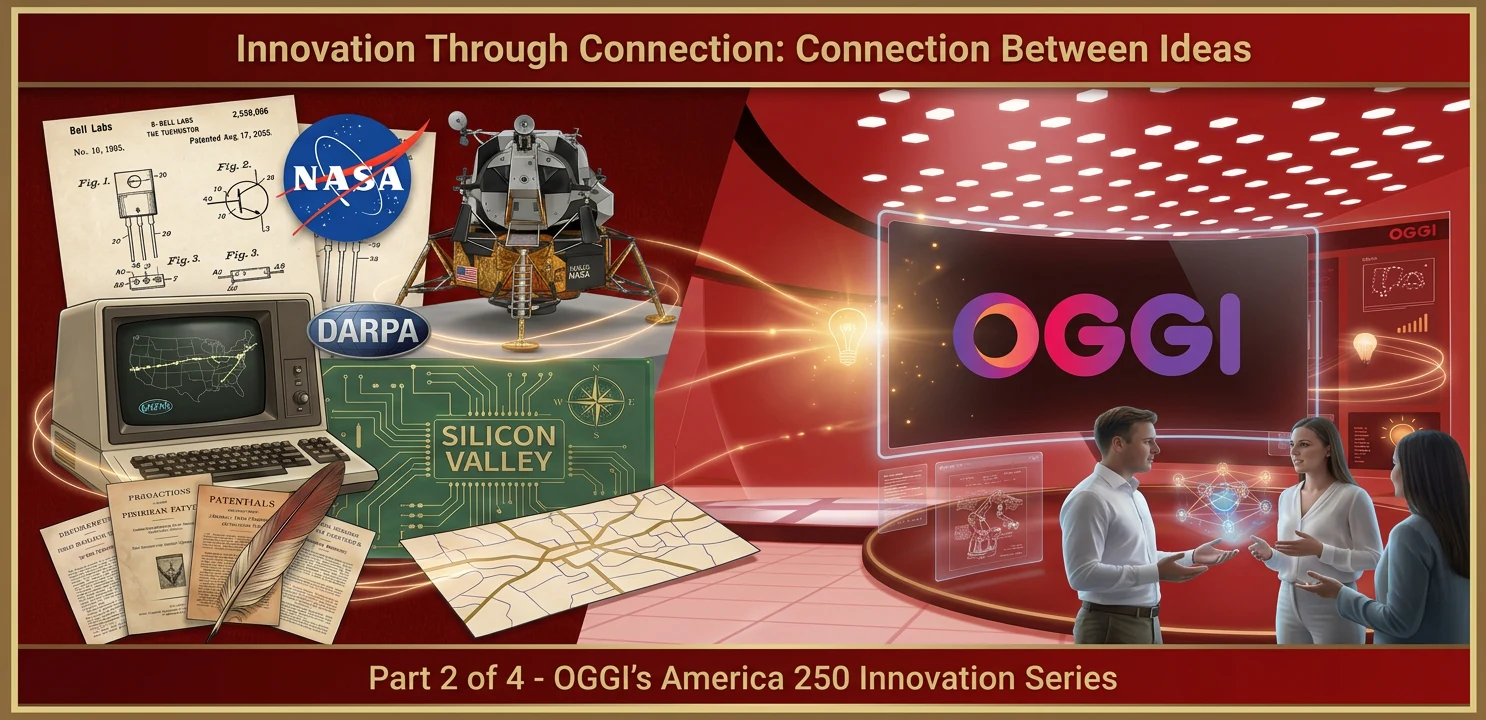
Part 2 of 4 in OGGI's America 250 Innovation Series
America's innovation story has never been about one idea moving in a straight line. It has been about ideas meeting other ideas.
A political philosophy meets a printing press. A scientific discovery meets an entrepreneurial mindset. A university lab meets a public mission. A human need meets a new technology.
That is where American innovation has often accelerated — not simply in the creation of ideas, but in the connection between them.
As we continue recognizing America's 250th year, it is worth remembering that some of the country's most important breakthroughs were not born in isolation. They emerged when people could debate, publish, challenge, adapt, test, improve, and share ideas across distance, disciplines, and generations.
If Part 1 of this series focused on connection between people, Part 2 is about connection between ideas — and why that has been central to America's ability to keep reinventing itself.
The American Revolution Was Also an Idea Network
Before America became a nation, it became a conversation.
The Revolution was not only fought on battlefields. It was shaped in taverns, meeting houses, churches, newspapers, pamphlets, committees, and letters moving from colony to colony.
Documents like Thomas Paine's Common Sense helped transform political frustration into a shared public argument for independence. The pamphlet spread rapidly through the colonies and gave ordinary citizens a clearer language for ideas that had been building for years: liberty, representation, self-government, and independence.
The Declaration of Independence itself was not a single isolated act. It reflected ideas from Enlightenment philosophy, colonial experience, legal tradition, religious conviction, economic frustration, and local self-governance.
America's founding was, in many ways, an act of synthesis.
It connected ideas about natural rights, consent of the governed, representative democracy, and civic responsibility — then turned those ideas into institutions.
That ability to connect ideas and organize them into action became one of America's defining strengths.
Innovation Needs More Than Invention
When we talk about innovation, we often focus on inventions: the light bulb, the airplane, the computer, the internet, artificial intelligence.
But invention is only one part of the story.
Innovation happens when ideas become useful, adopted, improved, and shared.
That requires connection.
A breakthrough in one field often becomes transformative only when it connects with another:
- Electricity connected with manufacturing, transportation, communication, and the home
- Flight connected with commerce, defense, migration, and global travel
- Computing connected with science, business, education, and personal communication
- The internet connected information, institutions, people, and markets
- AI is now connecting data, language, creativity, decision-making, and human collaboration
America's innovation engine has been powerful because it has repeatedly created environments where ideas can collide productively.
The Patent System: Connecting Ideas to Progress
One of the clearest examples of America's belief in innovation is built directly into the Constitution.
Article I, Section 8 gives Congress the power to promote "the Progress of Science and useful Arts" by securing rights to authors and inventors for their discoveries and writings.
That language matters.
From the beginning, the United States recognized that ideas could drive national progress — and that inventors needed both protection and incentive to share their work publicly.
The patent system did more than reward individual inventors. It created a public record of ideas. It allowed others to learn from previous discoveries, build on them, improve them, and create entirely new industries.
In that sense, patents are not only legal protections. They are connection points in the long chain of innovation.
They help transform individual insight into collective progress.
Land-Grant Universities and the Democratization of Ideas
Another major American contribution to innovation was the expansion of knowledge beyond elite circles.
The Morrill Act of 1862 helped establish land-grant universities focused on agriculture, engineering, science, and practical education. This was a major step in connecting advanced knowledge to the needs of a growing country.
The idea was powerful: education should not only preserve knowledge; it should apply knowledge.
Land-grant institutions helped connect research to farms, factories, communities, infrastructure, and industry. They created pathways for scientific and technical ideas to move into everyday life.
That model helped shape America's innovation culture:
- Knowledge should be useful
- Research should serve society
- Education should create opportunity
- Ideas should move from institutions into communities
This connection between learning and application became essential to American progress.
American Innovation Often Happens at the Intersections
Some of the most important American breakthroughs came from intersections — places where disciplines, sectors, and missions overlapped.
Consider a few examples:
Bell Labs
Bell Labs brought together physicists, engineers, mathematicians, and researchers in an environment where long-term scientific exploration could connect with practical communications challenges. Its work contributed to technologies including the transistor, information theory, lasers, and digital communications.
NASA
NASA connected science, engineering, national purpose, public imagination, and technological ambition. The Apollo program was not only a space achievement. It accelerated advances in computing, materials, telecommunications, systems engineering, and project coordination.
DARPA and the Internet
The early development of ARPANET, supported by the U.S. Department of Defense's Advanced Research Projects Agency, helped lay the foundation for what became the modern internet. A research project designed to connect computers became a global platform for connecting information, commerce, culture, and people.
Silicon Valley
Silicon Valley became powerful not simply because of individual companies, but because of the density of connected ideas: universities, capital, talent, risk-taking, defense research, entrepreneurship, and open exchange.
Again and again, American innovation has grown where ideas were able to meet.
AI and the Next Great Connection Between Ideas
Today, artificial intelligence is becoming one of the most important tools for connecting ideas.
AI can help people search, summarize, translate, analyze, generate, and discover patterns across enormous amounts of information. It can help connect disciplines that once felt separate. It can help researchers move faster, teams communicate more clearly, and organizations make sense of complexity.
But the real question is not only what AI can do.
The deeper question is what AI should help us become.
If used thoughtfully, AI can help restore something deeply human: the ability to understand each other better, collaborate more effectively, and bring ideas together across distance.
That matters because innovation is not just about speed. It is about direction.
The next chapter of American innovation will depend not only on how powerful our tools become, but on how well those tools help people connect, think, create, and solve together.
At OGGI, this is central to how we think about the future of digital interaction. Technology should not replace human connection. It should make connection more natural, more present, and more effective.
The next generation of innovation will not be defined by technology alone. It will be defined by how technology helps people and ideas meet in better ways.
America's Next 250 Years Will Be Built by Connected Ideas
As America approaches 250 years, the lesson is clear:
Innovation does not happen only because someone has a brilliant idea.
It happens when ideas are shared. It happens when ideas are challenged. It happens when ideas are combined. It happens when ideas move from theory to practice. It happens when ideas connect people to purpose.
From pamphlets to patents, from universities to research labs, from the internet to AI, America's progress has been shaped by its ability to connect ideas and turn them into action.
That is one of the great responsibilities of this moment.
As we look ahead, we should ask:
- Are we building tools that help ideas move more freely?
- Are we creating spaces where different perspectives can meet?
- Are we using technology to deepen understanding, not just accelerate output?
- Are we connecting innovation to human purpose?
Because the future will not be built by isolated ideas.
It will be built by connected ones.
About This Series
This is Part 2 of 4 in our Innovation Through Connection series celebrating America's 250 years of innovation. Start with Part 1: Connection Between People.
Visit OGGI to learn more about innovations in connection: enteroggi.com/blog
By Brian Clubb and Imelda Alejandrino
Sources and Further Reading
- National Archives — The Declaration of Independence — archives.gov
- Library of Congress — Thomas Paine's Common Sense — guides.loc.gov
- U.S. Constitution, Article I, Section 8 — Patent and Copyright Clause — constitution.congress.gov
- United States Patent and Trademark Office — Patent History and the U.S. Patent System — uspto.gov
- Library of Congress — Morrill Act of 1862 — loc.gov
- NASA — Apollo Program Overview — nasa.gov
- DARPA — ARPANET and the Origins of the Internet — darpa.mil
- Nobel Prize — The Transistor and Bell Labs — nobelprize.org
- National Institute of Standards and Technology — Artificial Intelligence — nist.gov
Next in the Series
Part 3 — Innovation Through Connection: Across Communities
How American innovation has helped people move, gather, build, organize, and grow across cities, states, industries, and shared missions.