
Innovation Through Connection: Across Communities
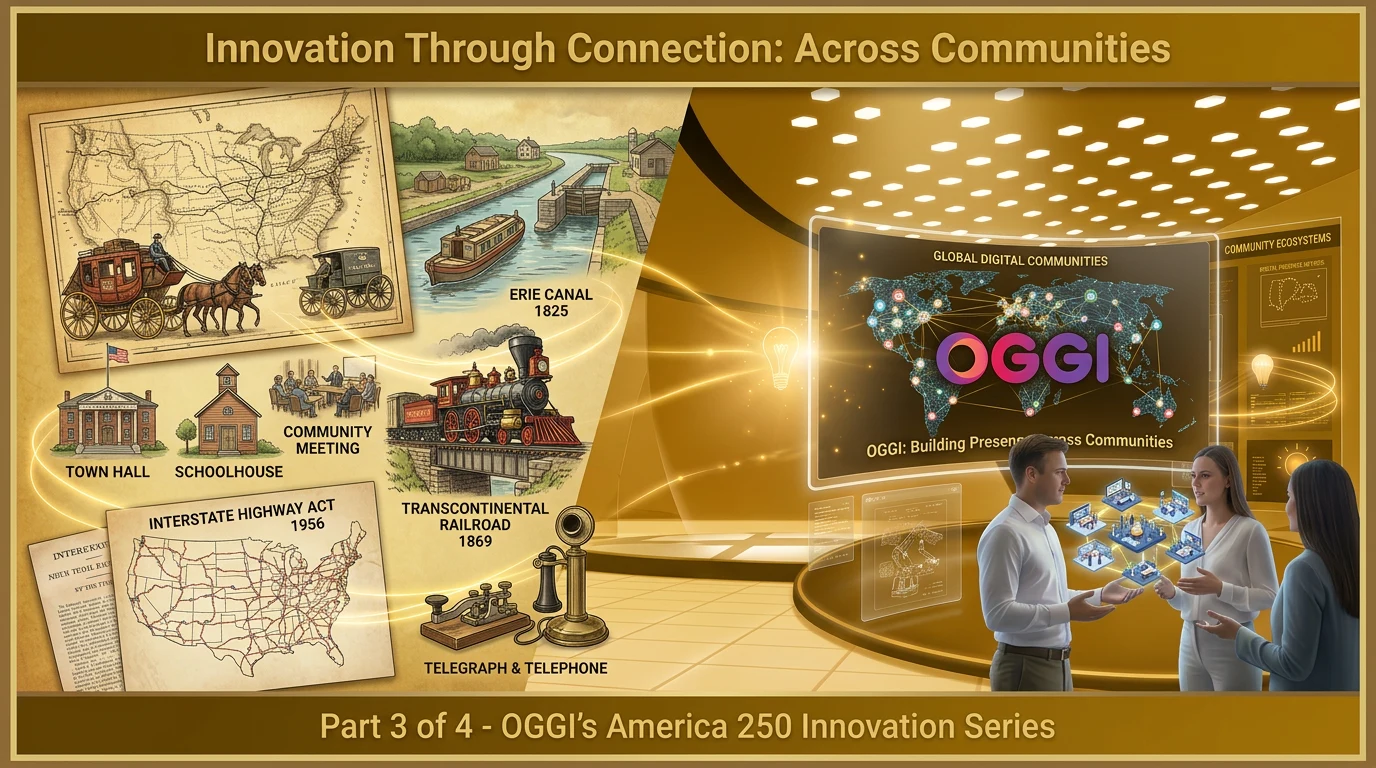
Part 3 of 4 in OGGI's America 250 Innovation Series
As America approaches its 250th anniversary, we are reflecting on one of the most powerful forces behind the country's progress: connection.
In Part 1 of this series, we explored connection between people — the human foundation of innovation. Before any breakthrough becomes a product, a movement, or a national achievement, it begins with people communicating, trusting, listening, and working together.
In Part 2, we explored connection between ideas — how America's greatest innovations often emerge when different disciplines, perspectives, technologies, and moments in history intersect.
Now, in Part 3, we expand the lens again. Because people and ideas do not exist in isolation.
They live inside communities.
Communities of builders. Communities of researchers. Communities of entrepreneurs. Communities of educators. Communities of workers. Communities of families. Communities of citizens. Communities connected by geography, purpose, belief, profession, identity, and shared ambition.
America's innovation story is not only a story of individual invention. It is also a story of what becomes possible when communities are connected across distance, difference, and common purpose.
This is the story of connection across communities.
A Nation Built by Connecting Communities
At the time of America's founding, the new nation was politically united by a revolutionary idea, but physically and socially fragmented.
Communities were separated by distance. Communication was slow. Travel was difficult. Markets were local. News moved by horseback, ship, printed papers, and word of mouth.
For the American experiment to work, communities needed ways to connect.
The early postal system became one of the first great networks of American connection. It carried more than letters. It carried newspapers, political arguments, commercial information, scientific thinking, and personal relationships.
Roads, ports, and waterways helped communities trade with one another. Towns became linked to cities. Farms became linked to markets. Citizens became linked to national conversations.
These systems were not just infrastructure.
They were early platforms for innovation.
They helped communities participate in something larger than themselves.
America's growth required more than independence. It required connection.
Infrastructure as Community Connection
Throughout American history, major infrastructure projects have repeatedly changed how communities connect.
The Erie Canal, completed in 1825, linked the Great Lakes with the Atlantic economy through the Hudson River. It dramatically lowered the cost and time required to move goods between inland communities and coastal markets.
Its impact extended far beyond transportation.
Farmers reached new buyers. Towns grew along the route. Commerce expanded. Migration increased. Ideas moved faster. Local communities became part of a broader national economy.
The canal showed that when communities become connected, opportunity expands.
Later, railroads transformed this idea on an even larger scale.
The First Transcontinental Railroad, completed in 1869, connected communities across the continent. What once took months could now take days. People, goods, mail, newspapers, raw materials, and manufactured products could move across the country with new speed and reliability.
Railroads did more than connect places on a map.
They connected communities to markets, labor, resources, information, and possibility.
In the 20th century, the Interstate Highway System continued this pattern. Authorized in 1956, it connected cities, suburbs, rural communities, military installations, industrial centers, and regional economies.
It reshaped commerce. It changed travel. It expanded logistics. It influenced where people lived and worked. It helped create new patterns of American life.
Each generation built the connection systems it needed for the future it imagined.
And each system made it easier for communities to exchange ideas, goods, services, culture, and opportunity.
Innovation Ecosystems Are Connected Communities
As America became more industrial, scientific, and technological, innovation increasingly depended on networks of communities working together.
The lone inventor has always been part of America's mythology, and individual creativity matters deeply. But major breakthroughs usually require more than one person and one idea.
They require ecosystems.
Inventors need manufacturers. Manufacturers need skilled workers. Workers need education and training. Researchers need funding. Entrepreneurs need customers. Startups need capital. Communities need infrastructure. Ideas need pathways to become real.
America's innovation history is filled with examples of connected communities creating extraordinary progress.
Bell Labs brought together scientists, engineers, companies, and communications infrastructure to produce breakthroughs that shaped modern life.
NASA connected government, universities, private contractors, engineers, astronauts, mathematicians, manufacturers, and mission-driven teams around one of the most ambitious goals in human history.
ARPANET connected research institutions and helped lay the foundation for what became the internet.
Silicon Valley became a powerful example of innovation across communities: universities, engineers, startups, venture capital, immigrants, large companies, risk-takers, and creative thinkers interacting in a dense network of talent and ambition.
These examples reveal a consistent pattern:
Innovation accelerates when communities are connected deeply enough to share knowledge, resources, trust, and purpose.
From Local Communities to Digital Communities
For much of American history, community was strongly tied to place.
A town. A neighborhood. A school. A factory. A church. A university. A laboratory. A main street. A meeting hall.
Physical spaces mattered because they gave people a shared context. They made it possible to gather, communicate, debate, build trust, and solve problems together.
Then communication technology began to expand the meaning of community.
The telegraph allowed messages to travel faster than people. The telephone allowed voices to cross distance. Radio and television created shared national experiences. The internet allowed communities to form beyond geography.
The internet changed the scale and speed of community connection.
Students could access knowledge from across the world. Researchers could share discoveries instantly. Small businesses could reach customers far beyond their local markets. Families could stay connected across states and countries. Professional communities could collaborate in real time. Creators could find audiences without traditional gatekeepers. Movements could organize at unprecedented speed.
Community no longer had to be defined only by physical proximity.
It could be defined by shared interest. Shared work. Shared identity. Shared purpose. Shared mission.
This was a profound shift.
But it also introduced a new challenge.
We became more connected than ever, yet often less present with one another.
The Modern Challenge: Connected, But Not Always Together
Today, communities stretch across geography in ways previous generations could hardly imagine.
Work teams are distributed across cities and countries. Families live across states and time zones. Students learn through digital platforms. Healthcare happens remotely. Businesses serve customers through screens. Professional networks form online. Civic conversations happen across digital channels.
The ability to connect is no longer the main limitation. The quality of connection is.
We can send messages instantly, yet still feel misunderstood. We can join meetings from anywhere, yet struggle to build trust. We can share information constantly, yet still feel disconnected. We can collaborate across tools and platforms, yet lose the natural human signals that make communication meaningful.
This is where the first three parts of this series come together.
- Part 1: Innovation begins with connection between people.
- Part 2: Breakthroughs happen through connection between ideas.
- Part 3: Progress scales through connection across communities.
The next frontier is not simply more communication. It is better connection.
Technology must help communities feel more present, more engaged, and more human — even when they are not physically together.
The Future of Community Connection
For centuries, communities have gathered in shared spaces to do important work.
Town halls. Classrooms. Laboratories. Conference rooms. Factories. Libraries. Houses of worship. Family rooms. Innovation hubs.
These spaces matter because they create presence. They help people read emotion, build trust, exchange energy, develop shared understanding, and collaborate naturally.
The question now is whether digital spaces can support that same depth of human connection.
Can technology help communities gather more naturally? Can it make remote collaboration feel more human? Can it restore a stronger sense of presence? Can it help people communicate with greater trust and clarity? Can it strengthen relationships across teams, families, customers, and communities?
At OGGI, this question is central to what we are building.
We believe the next era of innovation will depend on digital environments that do more than transmit information.
They must support human presence.
They must help communities connect with greater authenticity, clarity, and trust.
Because the future of work, learning, healthcare, customer engagement, and civic life will not depend only on faster technology.
It will depend on more human technology.
America's Pattern of Progress
Across nearly 250 years, America has repeatedly advanced by building new ways for communities to connect.
The postal system connected citizens, newspapers, businesses, and civic life. Canals connected inland communities to coastal markets. Railroads connected regional economies and national supply chains. Highways connected cities, suburbs, rural areas, and commerce. Universities connected research, education, talent, and industry. Government programs connected public purpose with scientific ambition. Laboratories connected disciplines, institutions, and invention. The internet connected knowledge, markets, networks, and digital communities.
Each new network expanded what communities could do together.
Each one transformed isolation into participation.
Each one made opportunity more accessible.
And each one reflected a larger truth:
Innovation grows when communities are connected deeply enough to share ideas, resources, trust, and purpose.
Looking Toward America 250
As America approaches its 250th anniversary, we are once again living through a major transformation in connection.
The question is no longer whether communities can communicate across distance.
They can.
The question is whether they can truly connect.
Can remote teams build the same trust as teams in the same room? Can families separated by distance feel more present with one another? Can students and teachers connect in ways that feel engaging and human? Can doctors and patients communicate with greater empathy and clarity? Can businesses create stronger customer relationships through digital interaction? Can communities use technology to strengthen belonging rather than weaken it?
These are not only technical questions.
They are human questions.
The next generation of American innovation may not be defined only by roads, bridges, wires, or satellites.
It may also be defined by digital environments that help communities gather, collaborate, create, and care for one another from anywhere.
That future will require more than innovation for its own sake.
It will require innovation with intention.
Conclusion
The American story is a story of expanding connection.
In Part 1, we explored how innovation begins with people. In Part 2, we explored how breakthroughs happen when ideas connect. In Part 3, we see how progress scales when communities are connected across distance, difference, and purpose.
From postal roads to railroads, from universities to laboratories, from highways to the internet, America has grown by building systems that help communities exchange knowledge, opportunity, and trust.
As we look toward America 250, the opportunity before us is clear: to build the next generation of technology that strengthens human connection across communities.
At OGGI, we believe that is one of the most important innovation challenges of our time.
Because the future will not be shaped only by what technology can do.
It will be shaped by how well technology helps communities come together.
This is Part 3 of 4 in our Innovation Through Connection series celebrating America's 250 years of innovation. Start with Part 1: Connection Between People.
Visit OGGI to learn more about innovations in connection: enteroggi.com/blog
By Brian Clubb and Imelda Alejandrino
Sources
- National Postal Museum — The United States Postal Service and the Expansion of America. Explores how the postal system helped connect people, communities, commerce, and civic life across a growing nation. postalmuseum.si.edu
- U.S. Postal Service — Postal History. Provides historical context on the role of the postal service in American communication and national development. about.usps.com
- Erie Canal Museum — Erie Canal History. Details how the Erie Canal connected communities, expanded trade, and accelerated economic growth in the early United States. eriecanalmuseum.org
- National Park Service — Erie Canalway National Heritage Corridor. Highlights the Erie Canal's role in linking communities and shaping transportation, commerce, and settlement. nps.gov
- Library of Congress — Railroad Maps, 1828–1900. Documents the expansion of railroads and their impact on connecting regions, communities, and markets across the United States. loc.gov
- National Museum of American History — America on the Move. Explores how transportation systems, including railroads, roads, and automobiles, transformed American life and connected communities. americanhistory.si.edu
- Federal Highway Administration — Highway History. Provides background on the development of America's highway system and its impact on mobility, commerce, and community connection. fhwa.dot.gov
- Dwight D. Eisenhower Presidential Library — Interstate Highway System. Offers historical context on the creation of the Interstate Highway System and its national significance. eisenhowerlibrary.gov
- National Science Foundation — A Brief History of NSF and the Internet. Explains NSF's role in expanding internet infrastructure and connecting research and education communities. nsf.gov
- DARPA — ARPANET and the Origins of the Internet. Provides historical context on ARPANET and the early digital networks that helped shape modern online connection. darpa.mil
- NASA — NASA History. Covers NASA's role in advancing scientific collaboration, national innovation, and large-scale technological achievement. nasa.gov
- Computer History Museum — Networking and the Web. Explores the development of computer networking, the internet, and the systems that reshaped how people and communities connect. computerhistory.org
Next in the Series
Part 4 — Innovation Through Connection: Connection Through Technology
Technology has always been more than tools, machines, or systems. At its best, technology is a bridge — and the next 250 years will be defined by the human connection it makes possible.